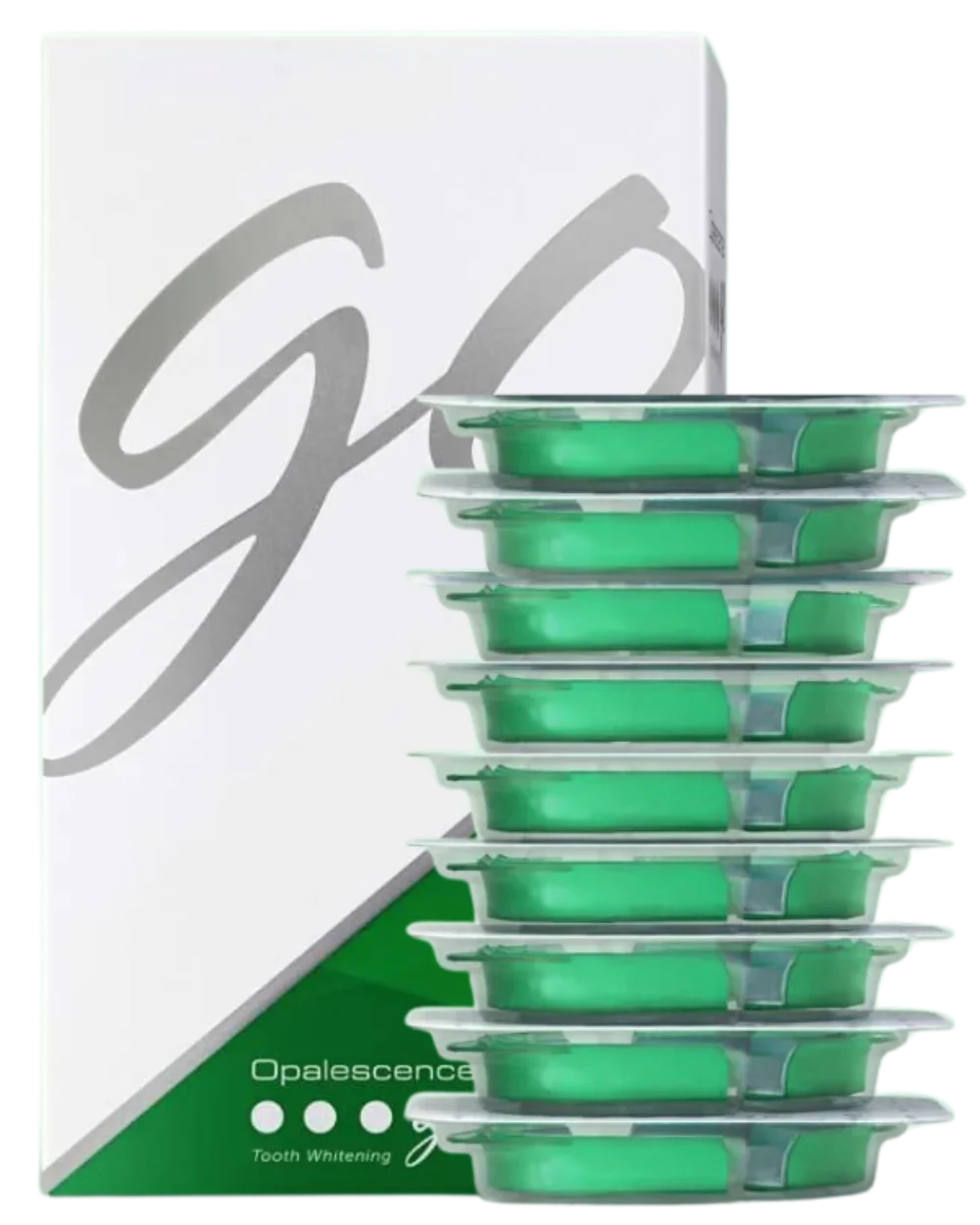
The group photo is on Saturday. You have a box of Opalescence Go on the bathroom counter, a friend who swears by it, and one question you keep circling: which of the trays goes in first, and how long do they actually stay in?
That hesitation is normal, and it is a good instinct. Opalescence is one of the most widely used whitening lines in dentistry, and it works well for most people who use it as directed. The directions matter more than the brand, though, so here is what the product family is, how the gel does its job, and how to use it without trading a brighter smile for a week of zingers.
What is Opalescence teeth whitening?
Opalescence is a family of peroxide whitening products made by Ultradent, a dental manufacturer. The name covers several different formats that people often lump together, and the differences between them explain most of the confusion online.
When most people search for Opalescence teeth whitening, they mean Go, the prefilled trays, or the PF gel their dentist handed them in a box of syringes. Those two are the focus here.
How does Opalescence whitening gel actually work?
Every Opalescence bleaching product relies on the same chemistry. Hydrogen peroxide is a small molecule that diffuses through enamel and into the dentin underneath, where much of a tooth's visible color sits. There it breaks down into reactive oxygen species that attack chromogens, the large pigmented molecules left behind by coffee, tea, wine, tobacco and age. Oxidized into smaller pieces, those molecules reflect less color, and the tooth reads lighter.
Carbamide peroxide, used in the PF gels, is a slower-release version of the same thing. It breaks down in the mouth into hydrogen peroxide and urea, and roughly a third of its weight ends up as hydrogen peroxide. That is why a 10% carbamide gel is gentler per minute than a 10% hydrogen peroxide gel, and why carbamide products usually call for longer wear times.
Ultradent labels its take-home gels PF for potassium nitrate and fluoride. Potassium nitrate calms the nerve response that causes whitening sensitivity, and fluoride supports the enamel surface during the course. Neither changes how the peroxide whitens.
Two practical consequences follow from the chemistry. First, the gel only works while it is in contact with your teeth, so fit matters. Second, it acts on natural tooth structure only. Crowns, veneers, bonding and fillings keep their original shade, which can leave an older front filling looking darker once the teeth around it lighten.
Opalescence Go trays: 10% or 15%?
Go trays come as an outer tray that holds the shape and a thin inner tray, already loaded with gel, that molds to your teeth once it warms up. You peel the outer shell away and the inner tray stays on. It is not a custom fit, but it is closer than a flat strip, which is the main reason people choose it.
The 15% version is the more common one and is worn for shorter sessions. The directions supplied with the 15% trays usually call for about 15 to 20 minutes a day over roughly five to ten days. The 10% version is milder and uses longer sessions. Higher concentration does not mean better results. It mostly means the same result arrives faster, with a somewhat higher chance of sensitivity along the way.
- You want something more even than strips without waiting for custom trays
- Your teeth are fairly straight, so a universal tray seats well
- You want short daily sessions you can fit before work or after dinner
- Crowded or rotated teeth, where a universal tray can leave gaps and patchy results
- Deep or long-standing discoloration, which often needs longer total contact time with custom trays
- Front fillings or crowns you want to match, since whitening will not change their shade
How do you use Opalescence Go trays?
Always follow the insert in your box and any directions from your dentist, since formulations and wear times differ. The general sequence for Go looks like this.
Brush and floss first
Clean teeth let the gel sit directly on enamel instead of on a film of plaque. Brush gently with a fluoride toothpaste and rinse.
Seat the upper tray
Center it over your front teeth with the gel side against them, then press gently along each tooth. Some people close their lips around it and suck lightly for a second or two to draw it snug.
Peel off the outer tray
Grip the colored outer shell and pull it away. The thin inner tray should stay in place. Smooth it against the teeth with a fingertip, then repeat for the lower tray.
Wear it for the labeled time
For the 15% trays that is usually 15 to 20 minutes. Do not eat, drink, smoke or sleep with trays in. Wearing them longer does not buy extra whitening in proportion, but it does add sensitivity.
Remove, discard and rinse
Lift the trays out, throw them away (they are single use) and rinse or gently brush off any remaining gel. Wipe any gel that got onto your gums.
Right after a session your enamel is slightly more porous and a little dehydrated, which is why teeth can look extra white for a few hours. It also makes them easier to stain. For the first hour or so, skip coffee, red wine, curry and similar strongly colored foods.
Is Opalescence safe, and what about sensitivity?
For healthy teeth and gums, peroxide whitening used as directed is generally considered safe. It does not dissolve or thin enamel the way acidic drinks can. The two side effects people notice are both usually temporary.
Tooth sensitivity comes from peroxide and its byproducts reaching the dentin and the nerve inside the tooth, which produces short, sharp twinges, often with cold air or cold drinks. It tends to peak during the course and fade within a few days of stopping. Gum irritation shows up as white or tender patches where gel sat on soft tissue, and it typically settles within a day or two once you keep gel off the gums.
- Space out your sessionsSwitching to every other day gives the nerve response time to settle. The total number of sessions matters more than finishing quickly.
- Use a desensitizing toothpasteToothpastes with potassium nitrate or stannous fluoride, used for a week or two before and during the course, help many people.
- Drop to a milder strengthIf the 15% trays are too much, a lower concentration with longer wear often reaches a similar end point more comfortably.
- Stop and ask if it lingersPain that lasts after the session ends, or one tooth that hurts far more than the others, is worth a dentist's look before you continue.
Skip whitening and see a dentist first if you have an untreated cavity, a cracked tooth, gums that bleed readily, or a tooth that aches on its own. Peroxide reaching an open cavity or crack can be sharply painful. Swelling of the face or jaw, fever, or severe tooth pain is not a whitening issue at all and needs prompt in-person dental or urgent care.
How long do Opalescence results last?
For most people, results from a full course hold for months, and often a year or more, before a gradual drift back toward the original shade. How fast that happens depends mostly on what you drink and eat, whether you smoke or vape, and how well surface stain is cleared day to day. A few touch-up sessions every several months usually keep things where you want them.
That is also where a dentist's input earns its keep. If your teeth restain quickly, or one area never lightened, the cause may be something whitening does not address, like tartar, an old restoration or enamel changes. OneOral's whitening add-on ships Opalescence Go 15% trays, and members can message a licensed dentist before and during a course to talk through sensitivity, dental work and what shade change is realistic.
Is Opalescence Go better than whitening strips?
Can I eat or drink right after using Opalescence?
How often can I repeat an Opalescence Go course?
Does Opalescence work on crowns, veneers or fillings?
Is Opalescence safe during pregnancy or for teenagers?
Ready to Transform Your Oral Health?
Join thousands of members who are preventing cavities with OneOral.