
Someone holds up a phone, everyone leans in, and later you find yourself zooming in on your own teeth. It is a very ordinary way to become interested in whitening.
Before buying anything, it is worth separating two things that both get called staining. They have different causes and they respond to completely different fixes.
Extrinsic: colour sitting on the surface
Coffee, tea, red wine, cola and dark berries all carry chromogens — pigment molecules that cling to the protein film covering your enamel. This is surface staining. It builds slowly, it is what most people are actually looking at, and it is the kind that responds well to whitening.
Intrinsic: colour coming from underneath
Enamel is semi-translucent. Under it sits dentin, which is naturally yellow. As enamel thins, more of that dentin shows through, and the tooth reads darker even though nothing has stained it. Age, grinding, and acid wear all thin enamel. Whitening gel does far less here, because the colour is not on the surface to lift.
The part people miss: acid, not pigment
Coffee at pH 5, wine nearer pH 3.5, cola lower still. Enamel begins to demineralize below roughly pH 5.5. So the drink is doing two things at once: leaving pigment behind, and briefly softening the surface it is leaving pigment on.
Brushing straight after something acidic can do more harm than waiting. The surface is temporarily softened, and scrubbing it is when wear happens. Rinse with water, wait about thirty minutes, then brush.
Habits that are worth the effort
Where whitening fits
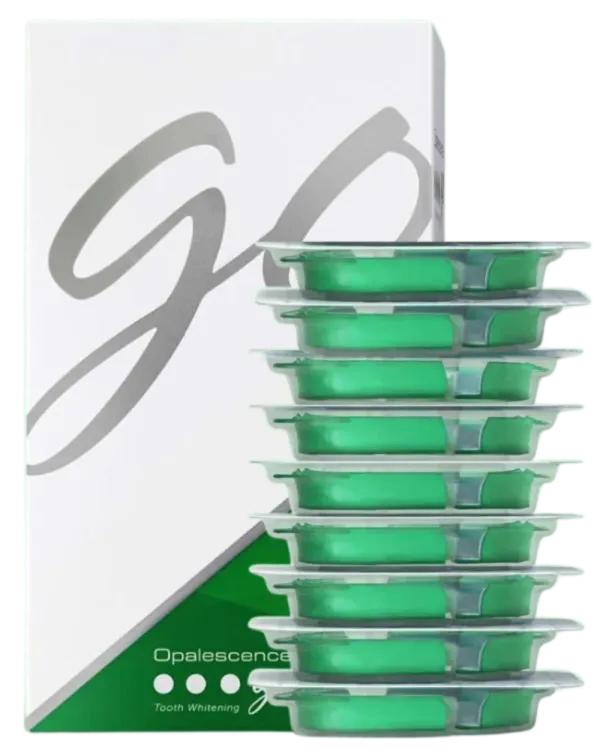
For surface staining, a peroxide gel in well-fitting trays is the straightforward answer. OneOral's Whitening Routine uses prefilled, single-use trays at 15% hydrogen peroxide — no impressions, no lab step. Sensitivity is the usual reason people abandon whitening, and it is more often about fit and contact time than about strength.
If a session stings, shorten it before you reduce frequency. A remineralizing toothpaste with nano-hydroxyapatite on the days between sessions helps the surface recover.
Does a straw actually help?
Is whitening bad for enamel?
How white is realistic?
Ready to Transform Your Oral Health?
Join thousands of members who are preventing cavities with OneOral.